
I visited Audeum, an audio museum in Seoul, and joined a guided tour with about twenty people. As we moved from gallery to gallery, our guide played music through different vintage speakers. We began with home hi-fi equipment and worked our way back through the history of recorded sound.
From Living Rooms to Movie Theaters
The first gallery was lined with wooden speaker cabinets and rows of amplifiers. Our guide pointed out the JBL Hartsfield, a home speaker with a round horn perched above its cabinet. It was easy to imagine some of these systems as the centerpiece of a living room.
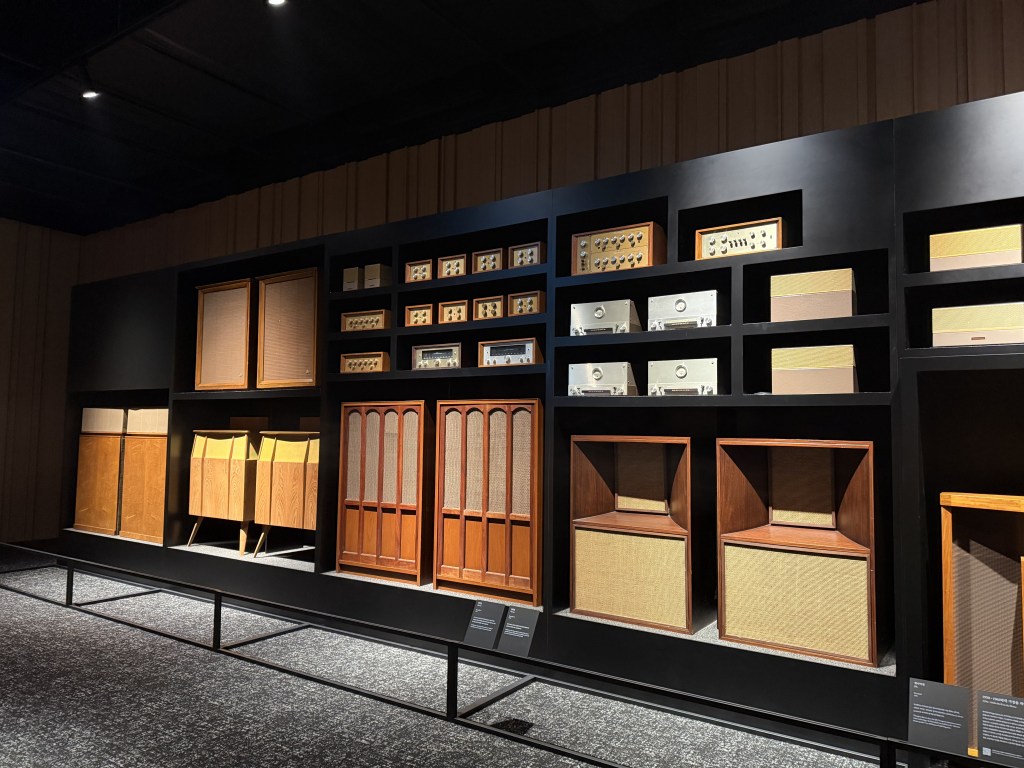
Home hi-fi equipment from the 1950s and 1960s.
The first piece we heard was Reynaldo Hahn’s À Chloris, sung by Susan Graham. Our guide played the same recording through two vintage cinema sound systems, first a Western Electric and then a Klangfilm. Hearing the song twice gave us a chance to listen for how the voice and piano sounded through each system. The piano opens the song on its own, with a descending bass line that recalls Bach’s Air.
Around that point in the tour, our guide told us a story about reservations. According to him, when Justin Bieber and his wife were in Seoul in October, they called to ask if they could visit Audeum. The museum turned them down because they hadn’t booked in advance.
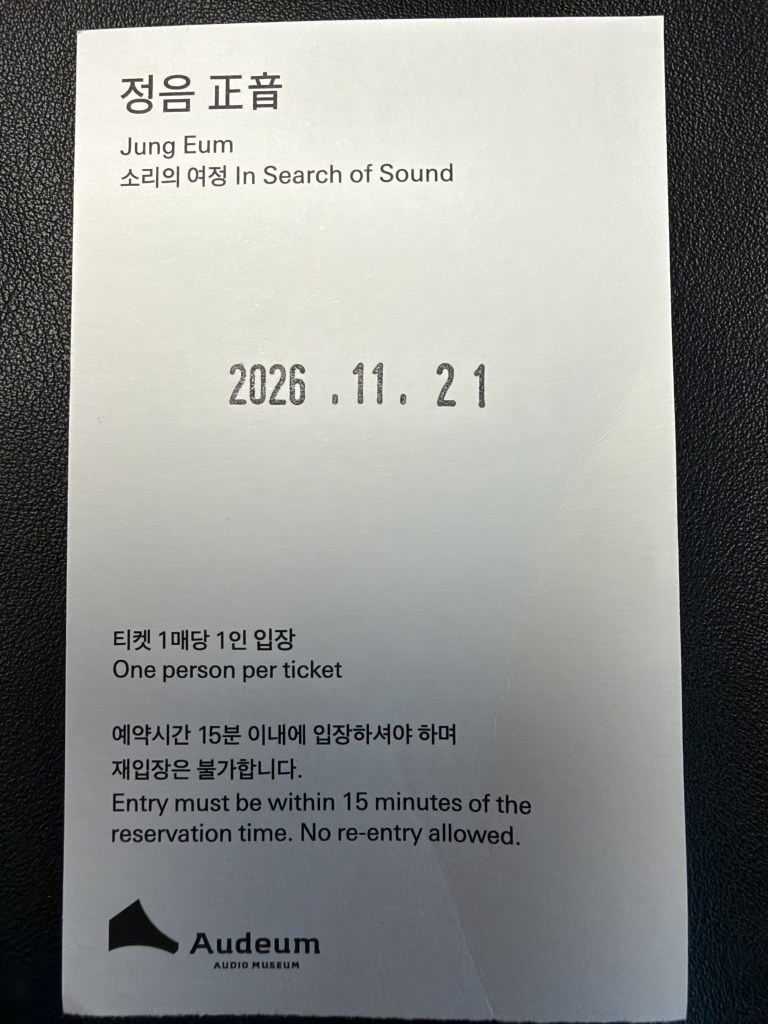
Justin would be so jealous of this! 😉
Studio Monitors
n the next gallery, our guide explained how sound engineers use a mixing console to balance the sound from different microphones. Studio monitors are speakers that let engineers hear that balance and check the sound.
Then our guide introduced the next recording as Woongsan’s version of “사랑, 그 쓸쓸함에 대하여,” a song originally performed by Yang Hee-eun.
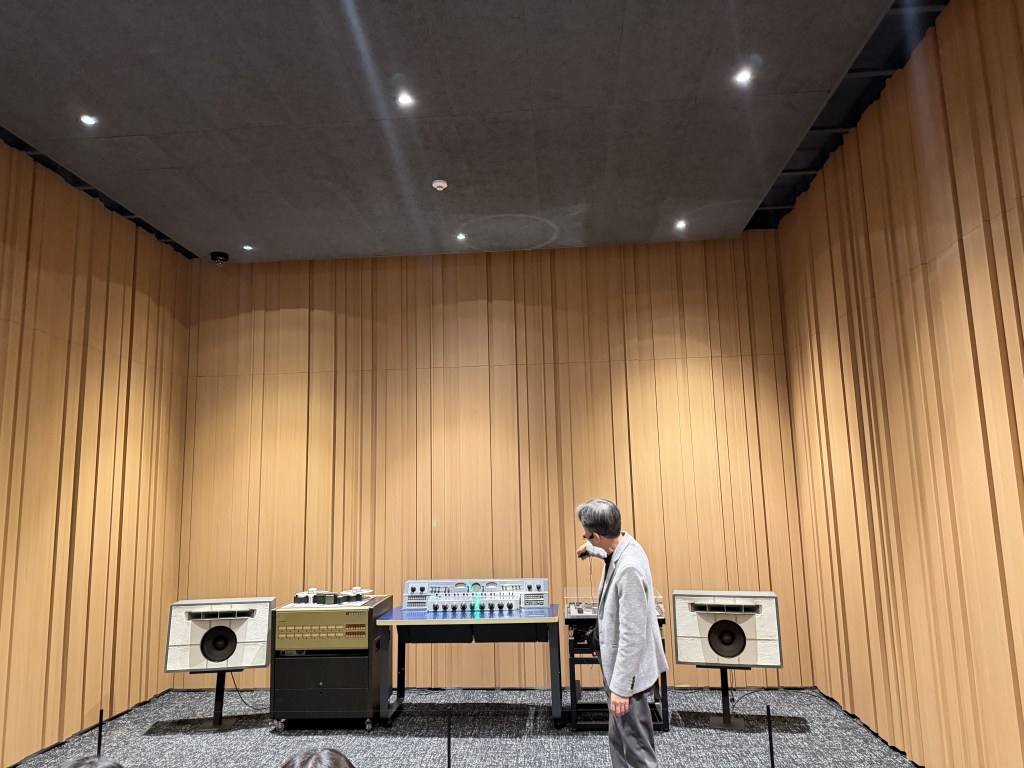
Western Electric 757A studio monitors flank a 25B broadcast mixing console at Audeum.
We also saw a Lyrec turntable. Our guide explained why dust and scratches were such a concern when making records. A tiny flaw on the master disc could show up on every copy made from it.
He said that record manufacturers were already using cleanrooms for this work fifty or sixty years ago. In his telling, today’s semiconductor factories borrowed the idea from the record industry.
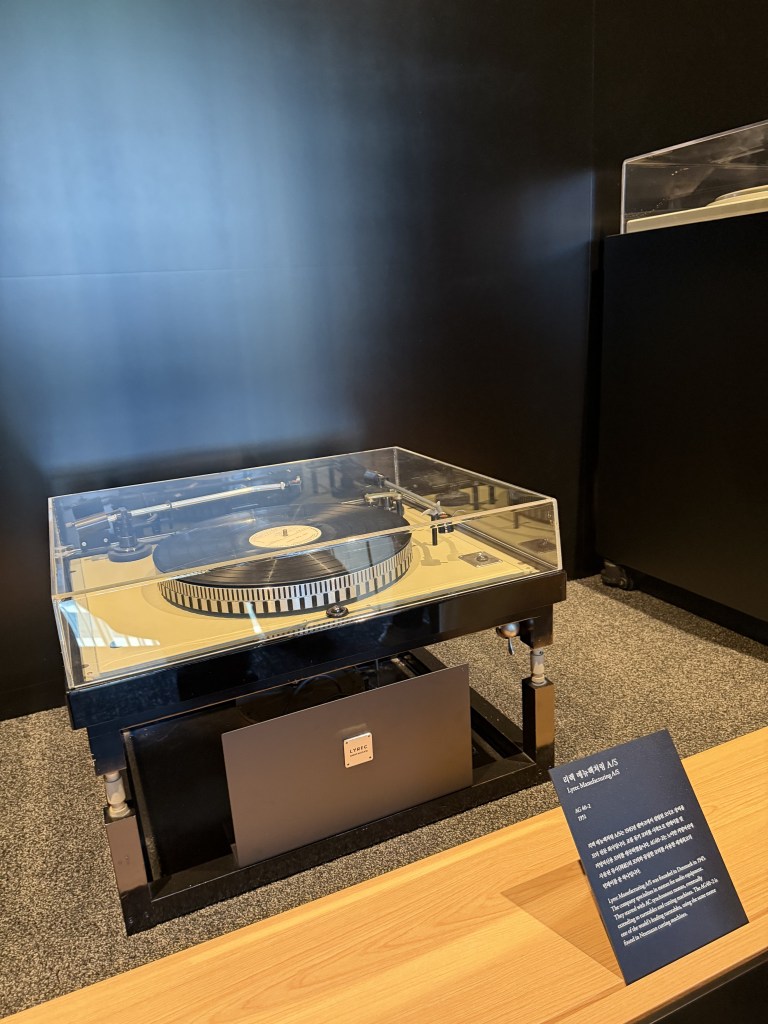
A Lyrec turntable on display.
A Voice in a Groove
The dark galleries opened onto a corridor lined with tall windows. Early phonographs stood against the late-autumn light. Our guide explained how the vibrations of a voice could move a needle and leave a trace on a turning cylinder. With flat discs, it became easier to make many copies from a single recording. He compared it to stamping out pieces of dalgona from a mold.
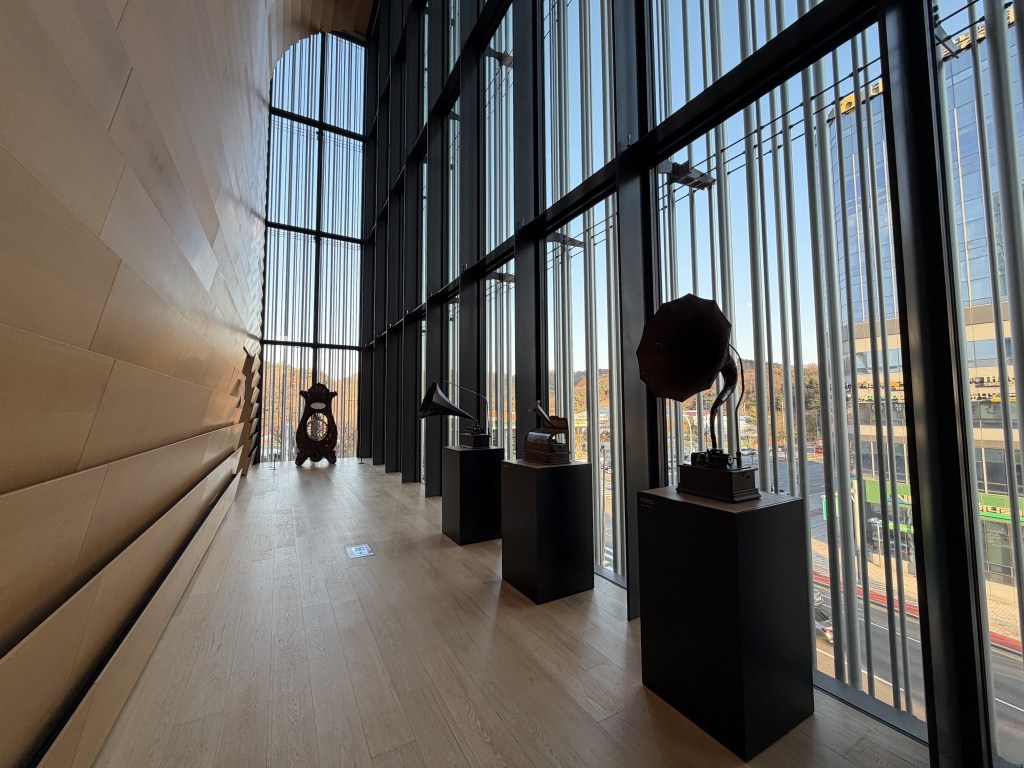
Early phonographs by the tall windows at Audeum.
Audeum was designed by Japanese architect Kengo Kuma and his firm, which also helped design the main stadium for the Tokyo 2020 Olympics. In the corridor where the phonographs stand, you can see the building’s vertical aluminum tubes just beyond the tall windows. Kuma’s team arranged the tubes to evoke the interplay of light and shadow in a forest. By the escalator, sunlight slipped between the tubes. As I moved from room to room, I could smell hinoki cypress throughout the museum.
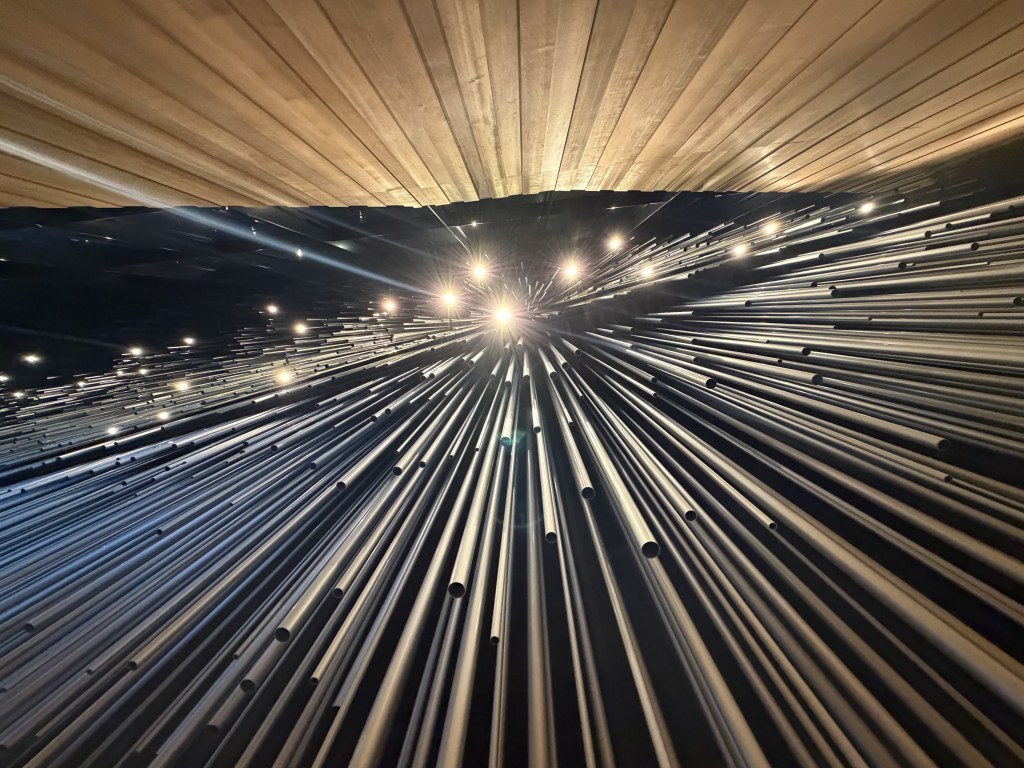
Looking up through a canopy of aluminum tubes inside Audeum.
The Sound Behind the Screen
Some of the old cinema speakers looked like bats hanging from the ceiling. Our guide explained that the space behind the screen was often narrow, so the horns had to fit into a shallow space.
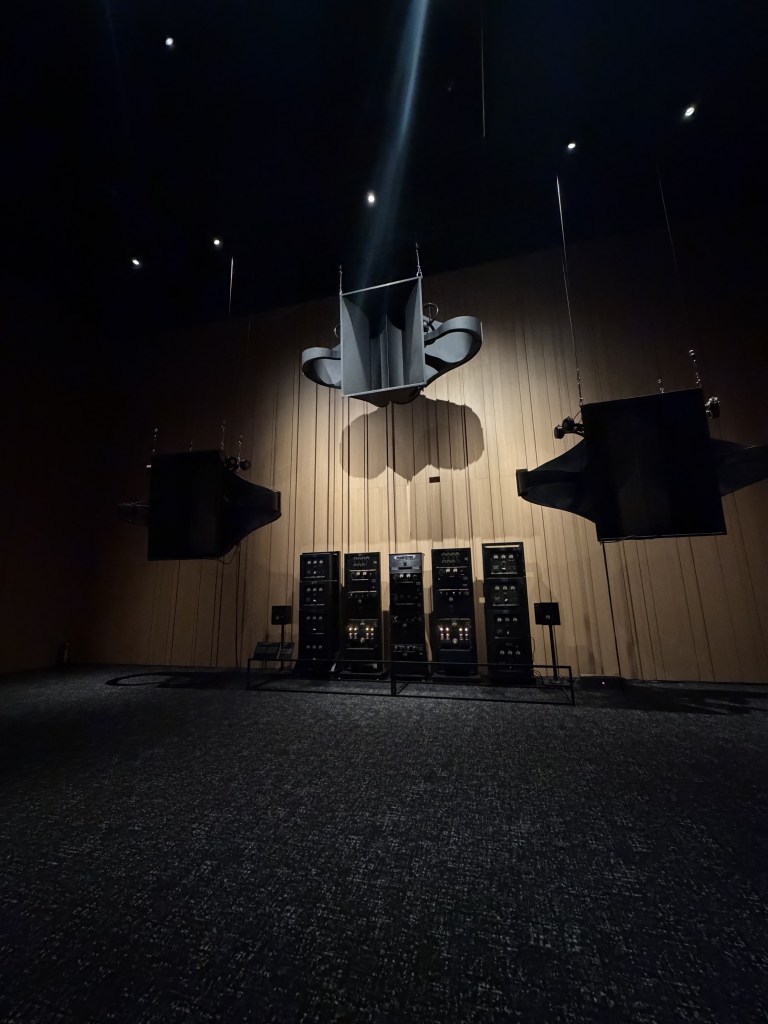
Vintage cinema horns suspended above their amplifier racks.
We heard Tony O’Malley’s “My Way” through vintage cinema sound equipment. Later, we listened to Kim Kwang-seok’s “Around Thirty” through a century-old public-address speaker system. We also heard the Beatles’ “Yesterday.” I’d heard it many times before, and I loved hearing it here.
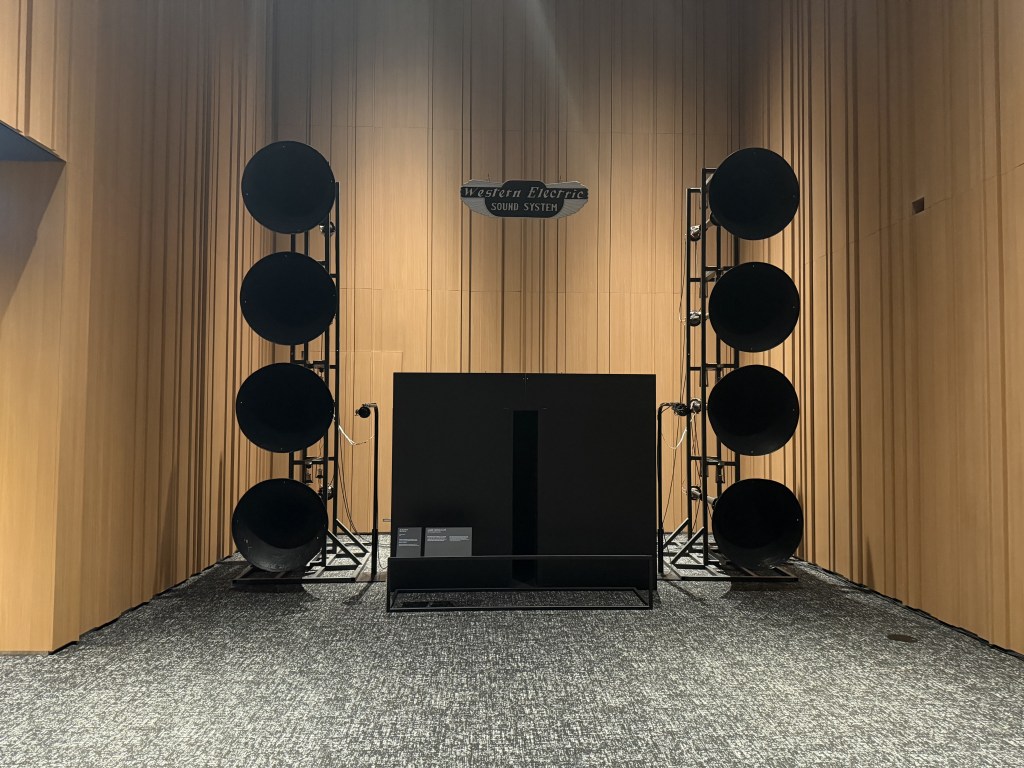
A Western Electric sound system in one of the later galleries.
Listening in the Lounge
Our tour ended in Audeum’s listening lounge.
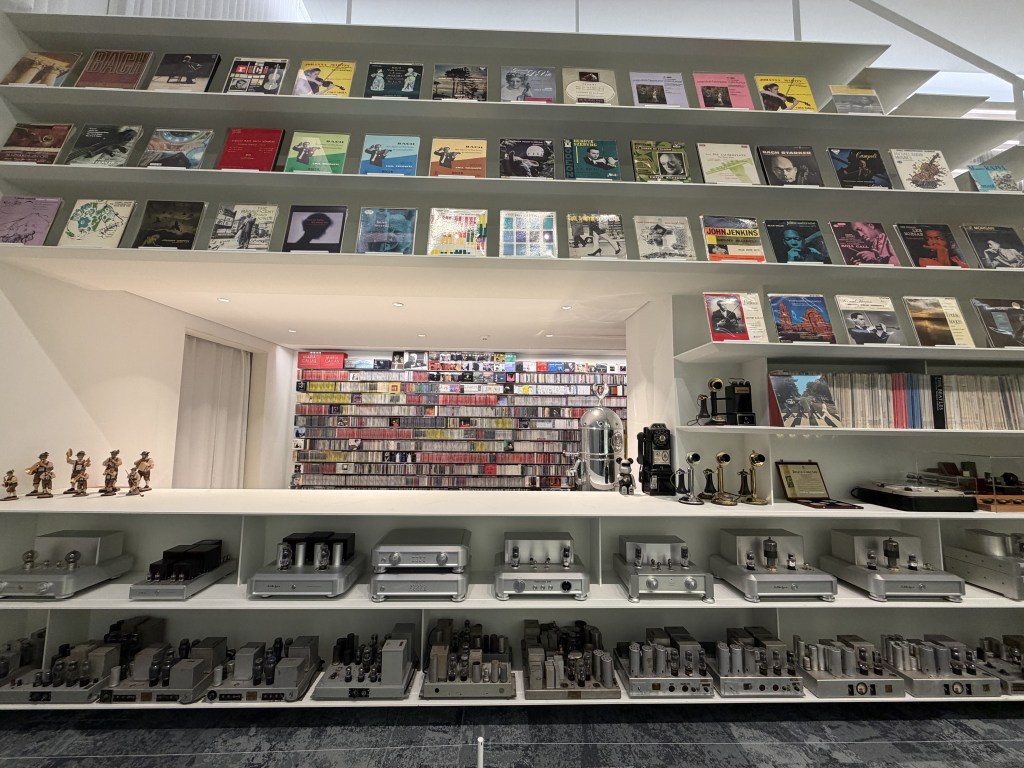
Records, CDs, and vintage amplifiers in Audeum’s listening lounge
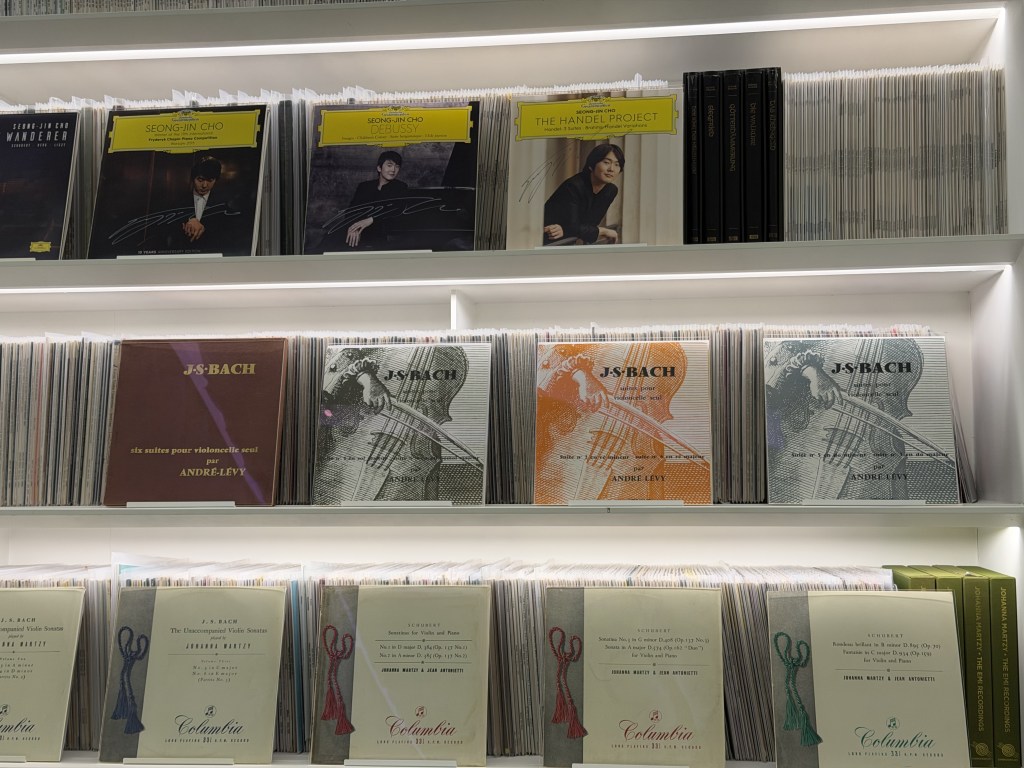
Album covers faced outward above rows of vintage amplifiers. Our guide pointed out a boxed LP set of Bach’s six suites for solo cello and described it as one of the rarest and most valuable sets in the collection.
White folds of fabric curved overhead, framing the ornate Mortier organ. Our guide also mentioned that the pianist Sunwook Kim had rehearsed at Audeum.
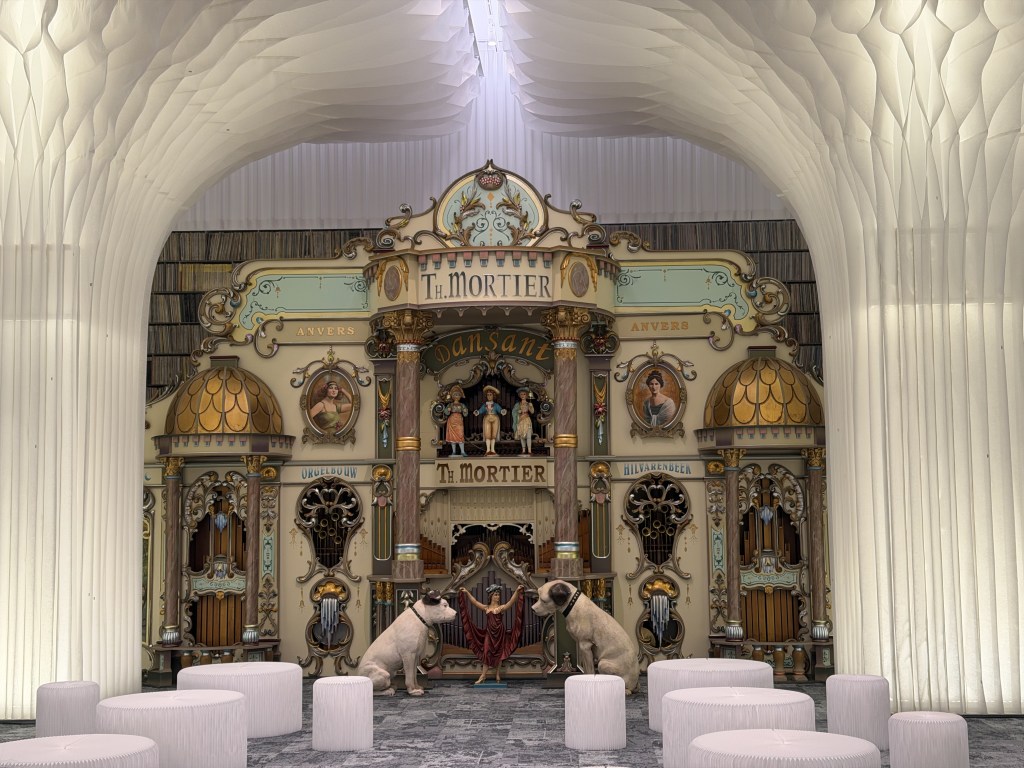
The Mortier organ in Audeum’s listening lounge.
Earlier in the tour, our guide had shown us several Western Electric Mirrophonic systems and told us we would hear the largest one, the M1, in the lounge. Here, Bach returned in a different form. Through the M1, we heard the Aria from the Goldberg Variations in Iiro Rantala’s jazz trio arrangement.
Our guide also introduced Lucia Popp’s recording of “Porgi, amor” from Mozart’s The Marriage of Figaro and Randy Crawford and Joe Sample’s “Lovetown.”
Every piece I heard at Audeum gave me chills. At times, it felt as though the musicians were right beside me. I’d never felt music so vividly in my whole body before.
After the visit, I looked up the score for Bach’s Aria, curious to hear how the opening measures would sound on my own piano. I also downloaded the sheet music for “À Chloris,” the first piece we heard that day, and tried playing it. It was lovely to hear that Bach-like bass line again, this time under my own fingers.
I was originally supposed to be at INZEUM that day. I was scheduled to lead a five-minute guided meditation as part of my training on November 21, but I’d already asked to postpone my practicum by a week.
Around noon that day, I happened to see Audeum in a YouTube Short. I looked it up and, to my surprise, there was a spot on a tour just three hours later. I booked it.
The funny thing is, looking back, it almost feels as though I postponed my practicum just to go to Audeum.
Something tells me I’ll be back soon.


Leave a Reply