The Hetu and Luoshu 하도낙서 河圖洛書: The Path to Unity between Heaven and Humanity (천일합일 天人合一)
Balgeunbit Tai Chi — Advanced Theory Lecture
By Master Kang Soo-Won · November 5, 2026
Watch Master Kang’s lecture on the same topic from five years ago.
Key Points
The lecture presents the Hetu and Luoshu (하도낙서) as a practical framework for understanding our relationship with nature and changing how we use our bodies, speak, and act.
They describe two inseparable aspects of one reality: the underlying order through which things take form and the way that order functions. Master Kang describes their unity in action as life.
Although we already embody nature’s principles, fixed habits and stubbornness can prevent us from responding appropriately. This appears both in continuing what we should stop doing and resisting what we need to do. Practice develops our ability to respond to each situation with appropriate words and actions.
Cultivating essence (정), vital energy (기), and spirit (신) involves caring for the conditions that sustain life, refining emotions and relationships through appropriate words and actions, and letting go of fixed assumptions so that we can see each situation as it is.
Refining emptiness (연허) means putting this training into practice through our everyday words and actions. Refining emptiness to unite with the Dao (도) —the Way (연허합도) means bringing our experience and actions into harmony with the natural order.
Tai Chi provides a system for learning and testing these principles through the body. Form practice (투로) develops familiarity with the movement sequence, precision, and connections between inner and outer activity (내외) and between the upper and lower body (상하). Pushing hands (추수) and partner practice (갈수) develop our ability to respond to another person. These skills are then carried into everyday speech and behavior.
The final discussion emphasizes continually checking our judgment. Repeated practice gradually improves the precision of our responses; it does not guarantee that we will respond perfectly in every situation.
***
1. The Lecture’s Starting Point and Scope
Tai Chi practice explores the interaction between the world around us and ourselves as the subjects who experience it. Master Kang connected this perspective to the East Asian philosophical tradition rooted in the Hetu and Luoshu (하도낙서).
He established three premises: to approach the subject from a practitioner’s perspective, to draw on the philosophical traditions that developed in East Asia, and to examine human life within that framework. A technical analysis of numbers, Chinese characters, or the detailed systems of the study of change was beyond the scope of this lecture.
The central themes were the relationship between humanity and nature, the unity of subject and object (주객합일), and the unity of Heaven and humanity (천인합일). Here, nature means the whole natural order to which we already belong, extending beyond the scenery we observe.
2. What Does It Mean to Become Complete as a Human Being?
The dictionary meaning of completion (완성) is to bring something fully to fulfillment. To be complete is to have everything necessary, with nothing lacking or deficient. Applied to human life, this raises a question: What must we fulfill, and what would it mean for nothing to be missing?
Master Kang brought together several expressions used in spiritual practice—awakening (깨달음), the dissolution of karmic obstacles (업장의 소멸), and a thorough transformation of body and being (환골탈태)—under the idea of completion.
Rather than providing an answer at the outset, he offered a question for contemplation: What would it mean to reach a point in our lives where we no longer yearn for anything? He returned to this question at the end of the lecture.
3. The Practical Question of Avoiding Misfortune and Seeking Good Fortune
Master Kang encouraged us to consider ancient spiritual practices and philosophies in light of the suffering people actually faced. He described threats to survival such as war, slavery, cruel punishments, hunger, and natural disasters.
These circumstances gave rise to a practical question: How can we avoid misfortune and seek good fortune (피흉취길 避凶就吉)? The discussion then turned toward human beings themselves, examining how our responses can contribute to suffering or help alleviate it.
When discussing birth, aging, illness, and death (생로병사 生老病死), Master Kang focused on how people experience and respond to these conditions. Even in similar circumstances, suffering can take different forms depending on how we receive a situation and our capacity to deal with it.
Later, he also acknowledged natural disasters and environmental destruction that individuals cannot prevent through their own efforts. His emphasis on our responses should therefore not be reduced to the claim that all harm caused by external circumstances is a matter of personal attitude.
4. Centeredness and Appropriateness, the Way and Virtue, and Letting Go of Self-Insistence
In centeredness and appropriateness (중정 中正), centeredness does not mean occupying a physical midpoint. It means seeing a situation as it is, without being fixed on either side. Appropriateness means allowing words and actions that fit the situation to emerge from that state.
Eating when hungry and sleeping when sleepy illustrate a response that meets the need of the moment. Drinking water when sleepy applies the response to thirst to a different condition. The underlying principle remains the same, while the particular action must change with the circumstances.
Master Kang also explained the Way and virtue (도덕 道德) through the relationship between a general principle and its particular expression. The Dao, or the Way (도 道), refers to the principles of nature and the objective order of the universe. Virtue (덕 德) is the concrete realization of those principles in our lives. Returning to the Way and gaining an objective perspective is only part of the process. Completion requires responding appropriately to each moment of everyday life.
Letting go of self-insistence and following the other (사기종인 捨己從人) involves releasing our fixed demands and opinions. Master Kang explained that this must extend into responding naturally to circumstances (응물자연 應物自然): meeting the reality before us and responding in harmony with it. He presented natural action without forcing (무위자연 無爲自然) in the same light, while connecting a thorough transformation of body and being (환골탈태 換骨奪胎) to the concrete training through which these principles become embodied.
5. Images, Numbers, Principles, and the Eight Trigrams
The Hetu and Luoshu (하도낙서 河圖洛書) are represented by arrangements of black and white dots. Master Kang explained them through images (상 象), numbers (수 數), and principles (리 理). Images convey forms and symbols; numbers express numerical relationships; and principles concern the underlying meaning, which can be explained in words. Although words help us understand, they can also fix our understanding into rigid concepts. The lecture therefore also explored how forms and numbers convey meaning before it is put into words.
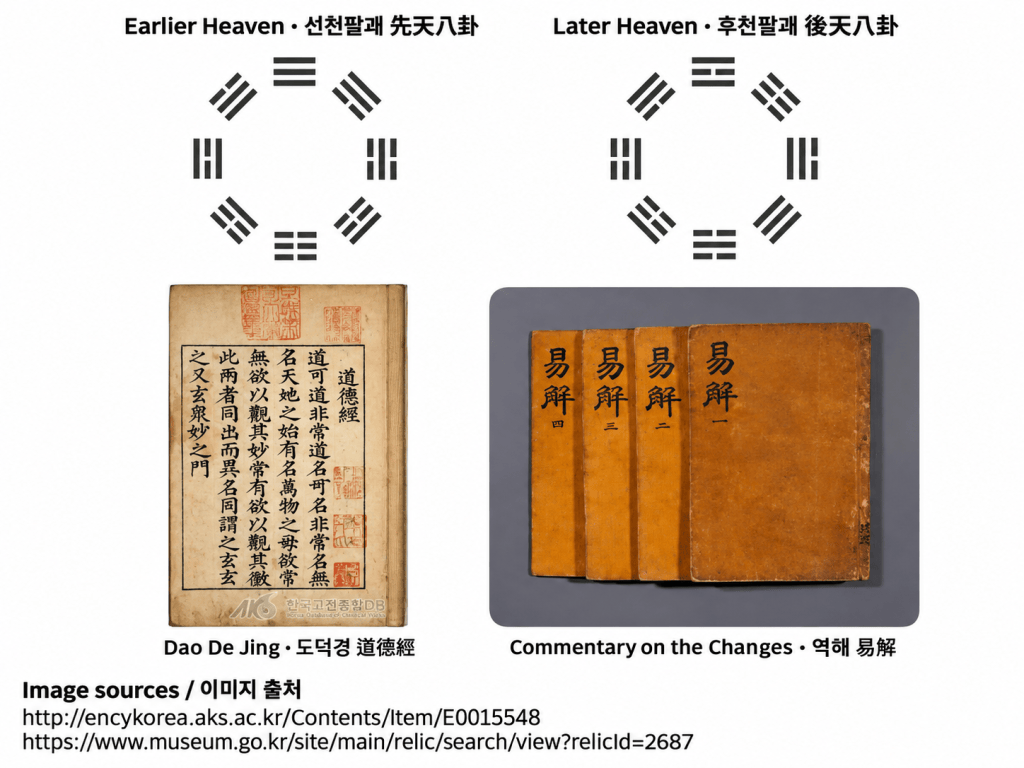
The Earlier Heaven arrangement of the Eight Trigrams (선천팔괘 先天八卦) was presented as an expression of the Hetu through trigram images, reflecting the perspective of Heaven and the source of creation. The Later Heaven arrangement of the Eight Trigrams (후천팔괘 後天八卦) was presented as an expression of the Luoshu, reflecting the perspective of the myriad things operating according to those principles. Master Kang explained their relationship in terms of underlying substance and its functioning (체용 體用).
6. The Legends of the Hetu and Luoshu
According to the legend introduced in the lecture, Fuxi (복희 伏羲) drew the Hetu (하도 河圖) after seeing patterns on the back of a dragon-horse (용마 龍馬) that appeared in the Yellow River. The Luoshu (낙서 洛書) was said to have been obtained by Yu the Great of the Xia dynasty (하나라 우왕 夏禹王) from patterns on the shell of a sacred turtle that emerged from the Luo River.
Master Kang approached these stories as symbolic legends. He contrasted the movement downward from Heaven with the movement upward from the water to explain the perspective of the source of creation and that of the myriad things.
7. The Hetu as the Foundation and the Luoshu as Its Functioning
In the Hetu (하도 河圖), the numbers are arranged in pairs: 1 and 6, 2 and 7, 3 and 8, 4 and 9, and 5 and 10. In the Luoshu (낙서 洛書), the numbers form a magic square around the central number 5.
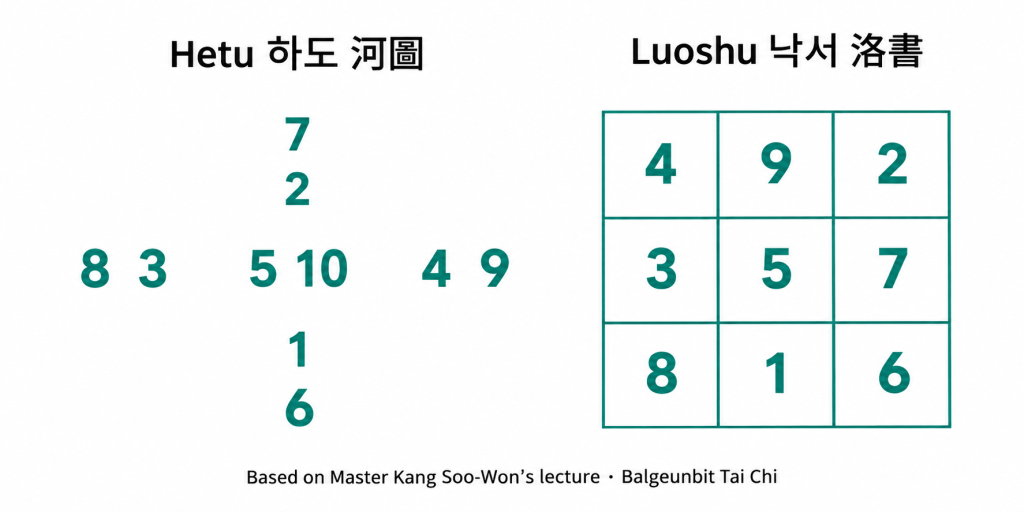
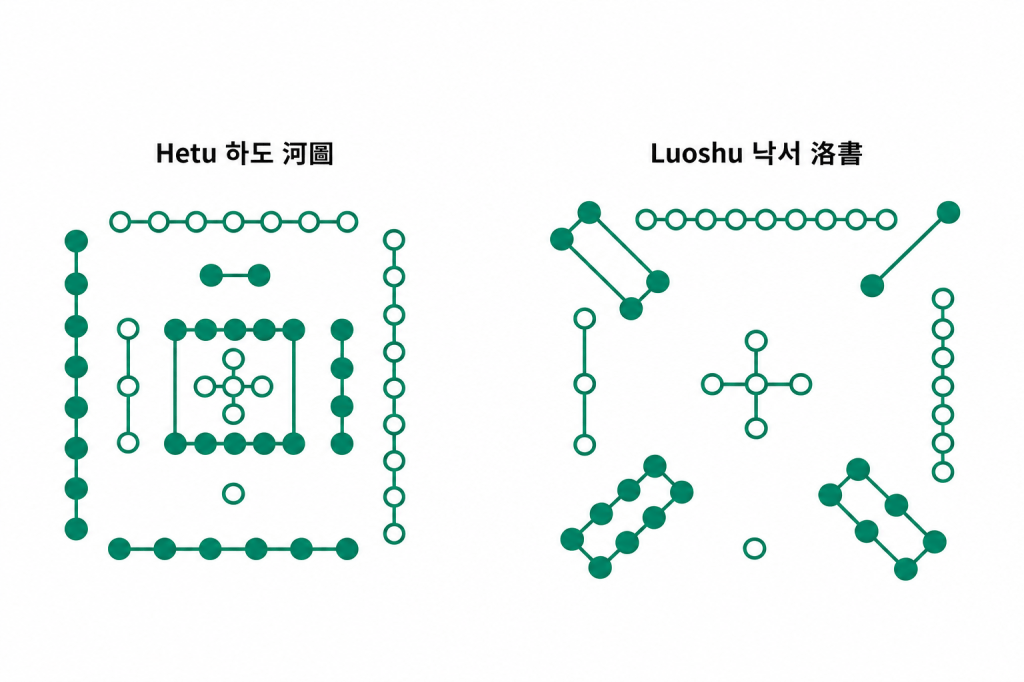
Master Kang cited Zhu Xi (주자 朱子), who described the Hetu as constant and the Luoshu as changing: the Hetu is the foundation of numbers, while the Luoshu expresses their functioning. He also introduced Dongju Choe Seok-gi’s (동주 최석기) explanation of the Hetu as the underlying substance from which yin and yang arise, and the Luoshu as their changing activity.
Constancy does not mean repeating the same behavior in every situation. The principle of remaining open and responding to circumstances stays the same, while its particular expression changes—as when we sleep when sleepy and drink water when thirsty.
| Perspective | Hetu (하도 河圖) | Luoshu (낙서 洛書) |
|---|---|---|
| The natural universe | Its form and structure | Its activity and functioning |
| The myriad things | Created things and the space they inhabit | Their activities and interactions |
| Analogy | A blueprint | A user’s manual |
| Standpoint | The source of creation | The beings brought into existence |
| Substance and function (체용 體用) | Foundation and underlying substance | Function and application |
The forms of the Earth, the Sun, galaxies, and living beings are considered from the perspective of the Hetu. The Earth’s rotation and orbit, seasonal changes, a dragonfly’s flight, and our activities of eating, sleeping, and studying are considered from the perspective of the Luoshu.
8. The Hetu and Luoshu Are One Inseparable Whole
The Hetu (하도 河圖) and Luoshu (낙서 洛書) are two perspectives on a single reality. Even when contrasting the creator with the myriad things, Master Kang emphasized that they should not be understood as separate, independently existing entities. In the lecture’s terms, the natural order experiences and expresses itself through the myriad things.
He compared this to looking at the same smartphone from the front or the back. The perspective changes, but the object remains one. In this sense, to understand the Hetu is to understand the Luoshu, and to understand the Luoshu is to understand the Hetu.
9. Number Pairs and Their Relationship to Space and Time
The five pairs in the Hetu (하도 河圖) express the structure of the natural universe through numbers. When intention takes concrete form, it appears in space as the Sun and Moon, mountains, seas, and the myriad things. In this sense, the Hetu is compared to a blueprint.
The Luoshu (낙서 洛書) represents the principles of functioning. Each pair of numbers opposite one another across the central 5 adds up to 10. Including the central 5 brings the total to 15. Each row, column, and diagonal also adds up to 15. Master Kang described 10, which does not appear explicitly in the Luoshu, as a hidden number, connecting it to the central pair of 5 and 10 in the Hetu.
Pairs of numbers opposite each other across the central 5 add up to 10. Every row, column, and diagonal adds up to 15.
10. Exploring the Hetu and Luoshu Through Finger Counting
Begin with one hand fully open. Fold the fingers down one at a time to count from 1 to 5, then unfold them one at a time to count from 6 to 10. The open hand at the beginning represents the empty state before creation. At 5, when all the fingers are folded, the myriad things have taken form. Unfolding the fingers from 6 to 10 represents their activity as they live and function.
Through this folding and unfolding, Master Kang illustrated the Hetu’s number pairs: 1–6, 2–7, 3–8, 4–9, and 5–10. For the Luoshu, he compared the hand shapes for pairs that add up to 10: 1–9, 2–8, 3–7, and 4–6.
Master Kang explicitly stated that there is no evidence that this finger-counting analogy was passed down from ancient times. Counting methods differ across countries, and he introduced this analogy as an explanation offered by Director Park Jong-Gu to help practitioners understand the diagrams. It should not be interpreted as assigning particular numbers to particular organs of the body.
11. Heaven Gives Form to Intention; Human Beings Express Intention Through Form
Using the eye as an example, Master Kang explained that, from Heaven’s perspective, form is created to fulfill the intention of perceiving light. From the human perspective, we see through eyes that have already been formed. The same applies to the nose: we breathe through the nose we have been given, rather than creating one for ourselves.
He also explained this relationship through substance and function (체용 體用). Before a form exists, intention serves as the underlying substance, and bringing that form into existence is its function. From the perspective of beings that already possess form, the form serves as the substance, and expressing its intended purpose through use becomes its function. Things with a visible form, such as a chair, and things without one, such as love or passion, were also used to illustrate the relationship between names and their corresponding functions.
The idea that we receive our bodies through the principles of nature, rather than create ourselves, leads to a later question about fate (운명 運命). Having been given certain conditions does not mean that every aspect of our lives is predetermined. Master Kang cautioned against turning this understanding into fatalism (운명론 運命論)
12. Each Ending Becomes a Beginning: Returning to the Question of Misfortune and Good Fortune
Master Kang explained each ending becomes a beginning (종즉유시 終則有始) as the principle that the completion of one movement provides the basis for the next. A movement does not simply stop when it ends; the next movement begins from that very point. Life and the activity of energy are likewise understood as cycles of arising, passing away, and beginning again.
In the finger-counting analogy, creation and functioning continuously follow one another. This principle provides a foundation for understanding linking every part into a continuous whole (절절관관 節節貫串) and the connection between movements discussed later in the lecture.
The discussion then returns to avoiding misfortune and seeking good fortune (피흉취길 避凶就吉). Although some circumstances lie beyond our control, we still have room to adjust our words and actions in response to the situation before us. The practical task of cultivation is to develop this appropriateness, reducing suffering and moving toward greater harmony.
13. The Objective World and the Subjective World
The objective world (객관의 세계) consists of the external circumstances unfolding around us, while the subjective world (주관의 세계) is ourselves as the ones experiencing them.
The photographs in the lecture moved from galaxies to Earth, from mountains and trees to small insects and other living beings, and finally to people speaking and acting within that world. Together, they revealed the wider context in which each of us exists as a living being.
Master Kang explained that viewing ourselves within this larger context can loosen our tendency to remain confined to our own bodies and perspectives. As an analogy, he described the sense of transcendent objectivity (초월적 객관성)that astronauts may experience when looking back at Earth from space.
14. Two Acts of Creation and the World of Lived Experience
Master Kang described two acts of creation (두 번의 천지창조): the world we actually experience opens where the objective universe meets the subjective universe of the person experiencing it.
He acknowledged that we can infer and establish that the world existed before we were born. At the same time, the world of our lived experience takes shape through our existence and experience. His explanation concerns how the world becomes a reality for us, rather than suggesting that we physically create the universe.
For example, a plate may break next door while I am at work. Although the event occurs, it is not part of my direct experience. For someone present, however, it is an experienced reality. Master Kang connected this perspective with phenomenology (현상학 現象學) and Maurice Merleau-Ponty (메를로퐁티).
He also described ancestral rites (제사 祭祀) as an expression of gratitude for the entire chain of life that has made our existence possible. This perspective extends beyond our grandparents and ancestors, tracing the origins of our lives back to the birth of the universe.
15. Laozi’s Way, the Myriad Things, and Their Unity
Master Kang connected the relationship between the Hetu and Luoshu with several paired expressions in Laozi’s teachings (노자 老子): “The Way that can be spoken of is not the constant Way” (도가도 비상도 道可道非常道)and “The name that can be named is not the constant name” (명가명 비상명 名可名非常名); the nameless and the named (무명·유명 無名·有名); the absence and presence of desire (무욕·유욕 無欲·有欲); and Heaven and Earth and the myriad things (천지·만물 天地·萬物).
A fish and a walnut tree have different names, forms, and ways of functioning, yet their common source can be described as the Dao, or the Way (도 道).
He then offered a question for contemplation: Are the Way and the myriad things the same or different? To say they are the same is mistaken; to say they are different is also mistaken. He left the question open and continued exploring their unity without treating them as separate realities.
16. Life as Unity in Action
Master Kang explained that life (생명 生命) is a word we can use to describe two differently named perspectives functioning as an inseparable whole: the Hetu and Luoshu, the creator and the myriad things, or the divine and the human. Life operated according to these principles before language existed, and living beings that cannot speak also participate in this activity.
| Relationship | First Perspective | Second Perspective |
|---|---|---|
| Hetu and Luoshu (하도낙서 河圖洛書) | Hetu (하도 河圖) | Luoshu (낙서 洛書) |
| Earlier and Later Heaven | Earlier Heaven (선천 先天) | Later Heaven (후천 後天) |
| Creation | The creator (창조주 創造主) | The myriad things (만물 萬物) |
| The divine and the human | The divine (신 神) | Human beings (인간 人間) |
| Analogy | A blueprint | A user’s manual |
| The world of experience | The objective world (객관의 세계) | The subjective world (주관의 세계) |
| Comparison with another tradition | Brahman (브라흐만) | Atman (아트만) |
These pairs were placed alongside one another to illustrate the structure of unity. The comparison does not imply that the teachings of these different traditions are identical in every detail.
Putting on clothes when cold, removing a layer when hot, sleeping when sleepy, and eating when hungry are basic examples of life in action. Once a need has been fulfilled, we no longer seek its fulfillment. Master Kang connected this state of fulfillment with completion (완성 完成), the question introduced at the beginning of the lecture.
The same principle applies to our words and actions. What matters is whether a response fulfills what the situation calls for. Words that sound good may still be inappropriate in their direction or timing, and repeating a familiar solution may leave the actual need unmet. The lecture described these relationships in terms of the direction, fulfillment, and circulation of energy.
17. Other Names for Life and the Question of Our Inherent Completeness
Master Kang introduced the Dao, or the Way (도 道), the Supreme Ultimate (태극 太極), and Buddha-nature (불성 佛性) as different names for life or the principles through which life functions. He placed several teachings alongside one another: the teaching in the Book of Changes (주역 周易) that the Supreme Ultimate gives rise to the two modes, yin and yang (양의 兩儀); the description of the Way as empty yet active; and the teaching that all sentient beings possess Buddha-nature.
Emptiness does not mean an absence of activity. It means that the direction of a response has not been fixed before the situation arises. When cold arrives, for example, activity takes the form of putting on warm clothing.
This leads to the question that opens the latter half of the lecture: If we already embody the principles of the Hetu and Luoshu, are we not already complete? Why, then, do suffering and unhappiness persist?
Master Kang also cited a statement to the effect that nature has completed its work, while the human task remains. He did not identify its precise source or establish its original philosophical context.
18. The Separation Between a Complete Source and Incomplete Human Experience
From the perspective of divine nature (신성 神性), the objective world (객관 客觀), the Way (도 道), and the greater Supreme Ultimate (대태극 大太極), the principles of life have already been bestowed. Yet from the perspective of human nature (인성 人性), subjective experience (주관 主觀), the myriad things (만물 萬物), and the lesser Supreme Ultimate (소태극 小太極), those principles may remain incompletely realized. Our continuing longing and difficulty responding in harmony with circumstances express this incompleteness. Master Kang described this as separation or disconnection (분리·단절).
To illustrate this separation, he brought together expressions from several traditions: Maya (마야), the expulsion of Adam and Eve, greed, anger, and delusion (탐진치 貪瞋癡) together with ignorance (무명 無明), and fixed patterns (태) discussed in East Asian cultivation.
He explained Maya through the image of a curtain obscuring our view, preventing us from seeing things as they are. The central point was that separation arises through our concrete words and actions.
19. Understanding Stubbornness as the Cause of Separation
Through passages from Mencius (맹자 孟子) and the Dao De Jing (도덕경 道德經), Master Kang examined resistance to Heaven’s will, rigidity, attachment, excessive accumulation, dissatisfaction, and hardness. In contrast, he presented knowing when we have enough, knowing when to stop, and remaining soft and flexible as ways of preserving life.
The image of water in “the highest goodness is like water” (상선약수 上善若水) illustrates freedom from stubbornness. Water does not contend with other things. It flows toward low places and changes its shape according to its surroundings, without insisting on maintaining one fixed form.
Master Kang explained that abstract expressions such as karma (업 業), sin (죄 罪), and fixed patterns (태) can be understood in everyday language as stubbornness (고집 固執). Here, fixed patterns refer to a state of being bound to one’s own perspective and unable to change.
20. Two Forms of Stubbornness and the Choice That Remains
The first form of stubbornness (고집 固執) is continuing to do what we should stop doing. Examples include speaking when it is time to be silent or being unable to let go of an argument. Master Kang described this as becoming fixed in the desires and patterns of energy arising within us.
The second form is refusing to do what we need to do. We may remain still when action is needed or postpone a necessary task while continually finding reasons to avoid it. He described this as resistance to the demands of the situation before us.
Both forms express a wish for an already existing, objective situation to change to suit our desires. By the time we recognize an event, it has already occurred and cannot be undone. Yet how we speak and act in response remains open. Practice works within that remaining space for choice.
21. Letting Go of Self-Insistence and Responding Naturally Do Not Mean Erasing Ourselves
Master Kang presented several expressions for overcoming stubbornness: letting go of self-insistence and following the other (사기종인 捨己從人), responding naturally to circumstances (응물자연 應物自然), overcoming self-centeredness and returning to propriety (극기복례 克己復禮), centeredness and appropriateness (중정 中正), natural action without forcing (무위자연 無爲自然), a thorough transformation of body and being (환골탈태 換骨奪胎), and harmony between yin and yang (음양화평 陰陽和平). Their shared direction is to release a rigidly fixed sense of self.
Letting go of ourselves does not mean eliminating the person who experiences and practices. It means loosening fixed convictions such as “This is simply who I am; I cannot change” or “I could never do that.” Depending on the situation, we may need to step forward or step back.
Master Kang likewise explained overcoming self-centeredness and returning to propriety as releasing our stubbornness and acting with sincerity and care in response to the situation. The aim is to respond appropriately, without fixing ourselves in a posture of either constant assertiveness or constant self-effacement.
22. Reconnecting with the World When Feeling Intimidated by an Audience
Master Kang described situations in which a speaker might feel overwhelmed: arriving to teach an audience of 500 people or being asked to instruct distinguished professors. He explained that we should examine the fixed patterns within us (태) that respond to the audience’s size or status.
One way to shift our attention is to move from seeing the audience as one enormous presence to making direct contact with a single person. Ask where they have come from, whether they have practiced Tai Chi, or what they hope to learn. Listen to the answer, and let the lecture develop from there.
As we listen and respond, attention that was caught within us turns outward. Other audience members can also engage with a discussion arising from their shared circumstances. The essential point is to restore the flow between inner and outer activity (내외), rather than force ourselves to say something entertaining.
Master Kang explained that, in this situation, struggling inwardly against anxiety or repeatedly telling ourselves that we are fine may keep our attention fixed on the discomfort. Instead, we can turn toward what is actually before us: someone’s voice, expression, clothing, or a feature of the room.
23. Understanding Natural Action and Embodied Transformation in Practice
In the lecture, Master Kang explained natural action without forcing (무위자연 無爲自然) as acting from emptiness: allowing an appropriate response to emerge through contact with another person and the situation, without placing fixed demands first. Acting according to a predetermined personal approach, regardless of the circumstances, becomes stubbornness. Such an action may happen to fit a situation, but that coincidence alone does not indicate completion in practice.
A thorough transformation of body and being (환골탈태 換骨奪胎) involves training the body to change its habitual patterns. Master Kang described how, when anger arises, energy in the chest and jaw may move forward and upward. That direction is not inherently wrong. It may be needed when responding quickly or speaking firmly. The difficulty arises when the same pattern takes over even when the situation calls for listening calmly or stepping back.
The aim is therefore to refine the body’s ability to use a particular movement of energy when needed and shift to another response when it is no longer appropriate. Harmony between yin and yang (음양화평 陰陽和平) describes the harmonious use of these different functions.
24. Three Areas Where Stubbornness Appears: Essence, Vital Energy, and Spirit
Essence (정 精) concerns the conditions that sustain life, including food, sleep, clothing, and shelter. Cultivation involves regulating these according to the circumstances. Master Kang gave examples of continuing to eat after having enough, or staying up playing games despite being tired. Moderation means doing what is needed and refraining from what is unnecessary.
Vital energy (기 氣) includes both emotions and the energy through which they arise and operate. Physical practice connects different flows and sensations through movement. Everyday life also requires practicing appropriate words and actions.
Master Kang illustrated this with someone who struggles to apologize. Rather than waiting for a complete change of heart, the person can try saying “I’m sorry,” even awkwardly. Experiencing the other person’s response may give them the courage to take another step. Outward speech and behavior can help guide inward emotion and energy. Some willingness to change must be present, however; no one else can do this work for us.
Spirit (신 神) encompasses mental activity as a whole. Master Kang described it as the root from which thought arises, before thoughts take shape in words. Refining spirit involves releasing fixed assumptions so that we can respond to reality without viewing everything through our own filters. This is how he explained refining spirit and returning to emptiness (연신환허 煉神還虛).
25. Supplementary Material: Essence, Vital Energy, and Spirit Through a Car Analogy
Master Kang briefly referred to the car analogy for essence, vital energy, and spirit (정기신 精氣神), inviting participants to photograph the table rather than reading through its repeated explanations. The table below summarizes the accompanying material.
| Aspect | Essence (정 精) | Vital Energy (기 氣) | Spirit (신 神) |
|---|---|---|---|
| Car analogy | Body, engine, wheels, steering wheel, fuel, and other components | Moving forward, reversing, turning, accelerating, and stopping | Navigation system and driver |
| Role | All the conditions that enable the car to function | The car’s movement and operation | Awareness and judgment appropriate to the destination and traffic conditions |
| Examples of failure | Insufficient fuel or a flat tire | Failure to regulate speed or brake properly | Failure to judge when to stop or change lanes |
| Interdependence | Cannot fulfill its function without vital energy and spirit | Depends on essence and operates appropriately under the guidance of spirit | Cannot carry out its intentions without essence and vital energy |
The material concludes that all three must work together for the car to function properly. They represent three interconnected aspects of one car, rather than three separate things.
26. Refining Essence, Vital Energy, Spirit, and Emptiness
Master Kang described the cultivation of the three areas in which stubbornness appears through refining essence (연정 煉精), refining vital energy (연기 煉氣), refining spirit (연신 煉神), and refining emptiness (연허 煉虛). He explained the elixir (단 丹) as another name for life, rather than a mysterious substance. The way of the elixir (단도 丹道) therefore concerns using that life appropriately and cultivating human completion.
In a passage attributed to Sun Lutang (손록당 孫祿堂), the way of the elixir is described as involving three transformations: refining essence into vital energy (연정화기 煉精化氣), refining vital energy into spirit (연기화신 煉氣化神), and refining spirit and returning to emptiness (연신환허 煉神還虛). Master Kang noted that these expressions originated in earlier Daoist cultivation traditions. The discussion then extended into refining emptiness in everyday life and uniting with the Dao.
| Stage | Cultivation as Explained in the Lecture | Everyday Expression |
|---|---|---|
| Refining essence (연정 煉精) | Regulating conduct concerning food, clothing, and shelter, and practicing moderation | Sleeping when needed and caring for the conditions that sustain life |
| Refining vital energy (연기 煉氣) | Refining the way emotions and relationships operate | Regulating emotions and practicing appropriate words and actions |
| Refining spirit (연신 煉神) | Releasing fixed assumptions at the roots of thought to respond to reality | Observing the situation before reaching conclusions from a habitual perspective |
| Refining emptiness (연허 煉虛) | Living through words and actions free from rigid insistence | Coordinating essence, vital energy, and spirit according to each situation |
Refining emptiness takes place in everyday life. Whatever our current mood, consideration for another person may be appropriate. Even when we strongly want something, the moment may call for stepping back. When an emotion arises, we can regulate its expression and try opening the conversation again.
27. Uniting with the Dao: Cosmic Order, Written Teachings, and Human Practice
Refining emptiness to unite with the Dao—the Way (연허합도 煉虛合道) means acting and speaking appropriately in everyday life with a mind free from fixed insistence. This returns the discussion to its opening theme: the unity of the Hetu and Luoshu, and of subject and object.
Cosmic change (천역 天易) refers to the encompassing order of the universe and nature. Written teachings on change (서역 書易) are the expressions people have left through numbers, images, speech, and writing after observing and recognizing that order. The Hetu and Luoshu belong to this category as human expressions, as do the Book of Changesand the explanations of later thinkers.
Human practice of change (인역 人易) means realizing these principles through actual conduct. Reading a book and agreeing with its wisdom does not, by itself, bring our lives to completion. The principles become realized when we actually say “I’m sorry,” consider whether expressing an emotion would be appropriate, or respectfully try opening a conversation again.
Master Kang emphasized that unconditional acceptance can also become stubbornness. There may be times when conflict is necessary, but our response must remain appropriate. Practice involves attending to the relationship between the actual situation and our words and actions, rather than applying one fixed attitude to every circumstance.
28. The Body as the Basis of Human Practice, and Tai Chi as Its Training System
Thoughts, emotions, speech, and actions all take place through the body. How we use the body shapes the direction of our feelings and thoughts, while our words and actions shape the world we experience. Master Kang described using the body in accordance with these principles as the human practice of change (인역 人易).
Tai Chi provides a system for practicing how to direct the body’s energy, respond to circumstances, and change our habitual responses. It begins and ends with the body. Beyond the training space, what we practice must find expression in everyday speech and behavior. Master Kang connected this with refining emptiness to unite with the Dao—the Way (연허합도 煉虛合道).
Examples of practical disciplines included Tai Chi (태극권 太極拳), Five Animal Frolics (오금희 五禽戲), Eight Pieces of Brocade (팔단금 八段錦), Microcosmic Orbit practice (주천공 周天功), and Tai Chi guiding and stretching exercises (태극도인 太極導引). The lecture presented Tai Chi as a new language created to communicate the experience of unity through bodily practice.
The accompanying slides included Sun Lutang’s explanation of awakening as the union of martial practice and the Dao, Chen Xin’s account of respectful practice extending into seeing, listening, speaking, and acting, and a passage describing partner practice as remaining in accordance with the natural order. Their shared emphasis was that bodily training and understanding the Dao belong together.
29. What Is Most Spiritual Is Most Embodied
Master Kang described the future as the space of words and actions that have yet to occur, rather than a predetermined timetable. The circumstances have already arrived, but how we respond remains open. Thought predicts from past experience and information; the body actually responds to the new situation.
When the body responds only through fixed patterns, different circumstances can produce the same emotions and behaviors. We may feel that we encounter only situations that provoke anger, while turning even opportunities or kindness into occasions for our habitual anger.
Master Kang described cultivation as awakening bodily functions we have not previously sensed, through the movement and connection of different joints. Pushing hands (추수 推手) and partner practice (갈수) provide opportunities to respond directly to another person through contact. This differs from first analyzing and interpreting each sensation and then deciding how to react.
To say that awakening the body’s responsiveness awakens the Supreme Ultimate (태극 太極) places the emphasis on living sensation and action. Master Kang compared the body’s recovery to water flowing through barren land, allowing trees and other life to return.
Cultivation means understanding cause and effect through the body. Good and ill fortune, misfortune and blessing (길흉화복 吉凶禍福) concern our ability to regulate ourselves in the small moments of everyday life.
30. Linking Every Part into a Continuous Whole: Connecting Inner and Outer Activity
Linking every part into a continuous whole (절절관관 節節貫串) means threading the individual sections together. Master Kang used bamboo as an analogy: its hollow spaces and solid nodes allow it to grow in length while remaining connected. He explained each section as bringing a movement to completion, and the linking as continuing into the next movement from that completed point.
Simply changing outward movements continuously is insufficient. An outward action must reach completion within, and that inward activity must then find expression outwardly. In Master Kang’s words, what is led from outside finishes inside, and what is led from inside finishes outside.
Through demonstrations, including the opening posture (기세 起勢) of the Yang-style form (양가 투로 楊家套路), he illustrated this alternating rhythm of inner and outer connection. Because parts of the explanation depended on gestures, words alone cannot fully reproduce the details. The movements themselves must be studied so that their rhythm becomes familiar through practice.
31. Inner and Outer Communication in a Conversation About Dinner
Someone suggests going out for dinner late in the evening. If we take in their words and recognize that they have not yet eaten, we might ask, “You haven’t had dinner yet?” and suggest having something simple together. Words arriving from outside are received inwardly and then expressed through further speech and action.
If we respond only from our own position—having already eaten—we might say, “Do you know what time it is?” This can create conflict. Although we have heard the words, we have processed them entirely through our own perspective.
The emphasis is on genuinely receiving and responding to the other person. A caring tone emerges naturally from that contact, rather than being deliberately put on.
Master Kang also described reacting sharply to a friendly hand placed on one’s shoulder because of a fixed personal habit. Even then, there is room to apologize, explain the habit, and reconnect. The appearance of stubbornness does not close off the choices that follow.
32. Why Embodied Transformation Requires a Training System
Small reactions that interrupt the flow of a relationship can occur from moment to moment, often without our awareness. Because tracing and resolving every cause individually is difficult, Master Kang proposed relearning how to use the body as a whole.
Form practice (투로 套路) provides a system for repeating established sequences and movement standards that cultivate harmonious bodily use. Pushing hands (추수 推手) then introduces another person as the actual circumstances to which we must respond. These practices must eventually extend into everyday speech and behavior.
Master Kang emphasized that noticing a fixed pattern in another person’s body does not give us permission to comment freely or intervene in their life. He compared this to opening someone’s front door and entering without permission. Such observations can inform our own cultivation; they do not authorize us to analyze or expose another person without their consent.
Cultivation requires a training system and relationships within which uncomfortable patterns can be addressed safely. Even a close relationship between master and student takes time. When resistance is strong, forcing the process can damage the relationship that makes learning possible. Master Kang also distinguished the person from the fixed patterns they have acquired.
33. Fate Expressed Through the Body, and Choices Still Open
From the perspective of the unity of body and mind (심신일원론 心身一元論), Master Kang explained good and ill fortune, misfortune and blessing (길흉화복 吉凶禍福), and fate (운명 運命) as finding expression through bodily activity. Yet our future words and actions have not occurred and remain open to choice. This possibility is central to cultivation.
The same circumstances can become an opportunity or a source of further conflict, depending on how we speak and act. Master Kang connected the possibility of changing our course through centeredness and appropriateness (중정 中正)with the Korean proverb, “A single word can repay a debt of a thousand nyang.”
He also described approaching someone who feels awkward at a gathering and offering them a cup of tea. We cannot know beforehand what connection might develop from that choice. The subsequent account of possible success was a hypothetical illustration of this openness, rather than an event presented as having actually happened.
34. A “Contract with Heaven” and the Relationship Between Upper and Lower Body
Master Kang used a contract with Heaven (하늘과의 계약) as a metaphor for the functions of the eyes, ears, mouth, hands, and other parts of the body. The circumstances and ways in which we use them vary, but we cannot arbitrarily change the basic relationship through which eyes see and ears hear.
In Tai Chi, he presented the relationship between upper and lower body (상하 上下) as one such fundamental principle. Movements may appear outwardly to open and close, while an internal connection between upper and lower remains at work.
A movement beginning in the legs reaches completion in the hands; a movement beginning in the hands reaches completion in the legs. Repeatedly practicing this mutual following of upper and lower (상하상수 上下相隨) connects inner and outer activity.
35. The Meaning of Gravity and Breathing in the Lecture
One slide states that resisting gravity sustains life, while collapsing under it leads to death. In the spoken explanation, however, Master Kang also used “resisting gravity” to describe bracing against an incoming force, encouraging participants to receive and work with it instead. These different contexts are preserved here rather than combined into a single definitive statement.
In this discussion, gravity (중력 重力) encompasses both physical forces acting on the body and, metaphorically, circumstances already confronting us, including another person’s pressure or emotionally charged words. Master Kang contrasted blocking these through resistance with facing, receiving, and responding to them.
He also connected birth and death, and life-supporting and life-constraining states, with inhalation and exhalation. These expressions belong to the lecture’s language of cultivation. They should not be read as physiological instructions suggesting that inhalation is harmful or that exhalation alone sustains life.
The central demonstration concerned how breathing becomes held during tension and releases during relaxation. Bracing against a hand pressing down on the shoulder creates tension; exhaling and releasing allows the pressure to be received. Here, breathing (호흡 呼吸) extends beyond the lungs to include the movement, relaxation, and release of different bodily regions.
36. Acceptance Does Not Mean Avoidance or Erasing What Happened
Facing gravity means acknowledging the reality already present and beginning to work with its force. Master Kang cautioned against interpreting this as simply discarding it. Avoiding or turning away from a situation does not necessarily resolve the state it has left within us.
Using shaking movements from Five Animal Frolics (오금희 五禽戲), he described moving and releasing force held in particular areas. His references to prolonged bodily fixation and illness are recorded here as part of his explanation of the body and energy.
Receiving, regulating, and redirecting another person’s pressure was also connected with issuing force (발경 發勁) in Tai Chi. Bracing more strongly against a fixed force is not the only possible response.
37. Obstructed Energy, Impatience, and Following the Movement
Master Kang described obstructed energy (횡기) as a disruption of flow caused by fixed internal patterns. Such obstruction can arise when we follow personal sensations and habitual methods rather than the principles of the movement.
He distinguished this from encountering a sense of obstruction while moving correctly. An existing restriction may be beginning to move and resolve. The presence of a blocked sensation alone therefore does not establish that the movement is wrong.
Discussing impatience, he distinguished an objectively urgent task from inward anxiety. When something genuinely requires speed, we can act quickly. Feeling hurried while not knowing what to do may instead reflect our own internal state.
In practice, the instruction is to follow the established sequence, movement standards, and appropriate rhythm of the form (투로 套路). Following the teacher’s movements helps that rhythm develop within the body, rather than allowing passing sensations to direct the practice.
38. The Closing Question
If you had become complete as a human being, what would you do now?
Master Kang left this as a question for contemplation (화두 話頭) rather than a theoretical problem with one correct answer. Completion concerns how we speak and act in the present situation. Even the act of attending the lecture provides an occasion for practice.
One participant offered the response, “How can I help?” Master Kang acknowledged the depth of that teaching while inviting further reflection on what this particular lecture and situation called for. He did not establish the phrase as the definitive answer.
In closing, he recommended an earlier related lecture for review and suggested future discussions of directing vital energy (운기 運氣), Laozi, embodied transformation, and essence, vital energy, and spirit. He described foundational theory as a brief overview of the whole map, while advanced theory examines individual subjects in depth.
He encouraged practitioners to bring these ideas into bodily training, and instructors to apply them in their teaching.


Leave a Reply